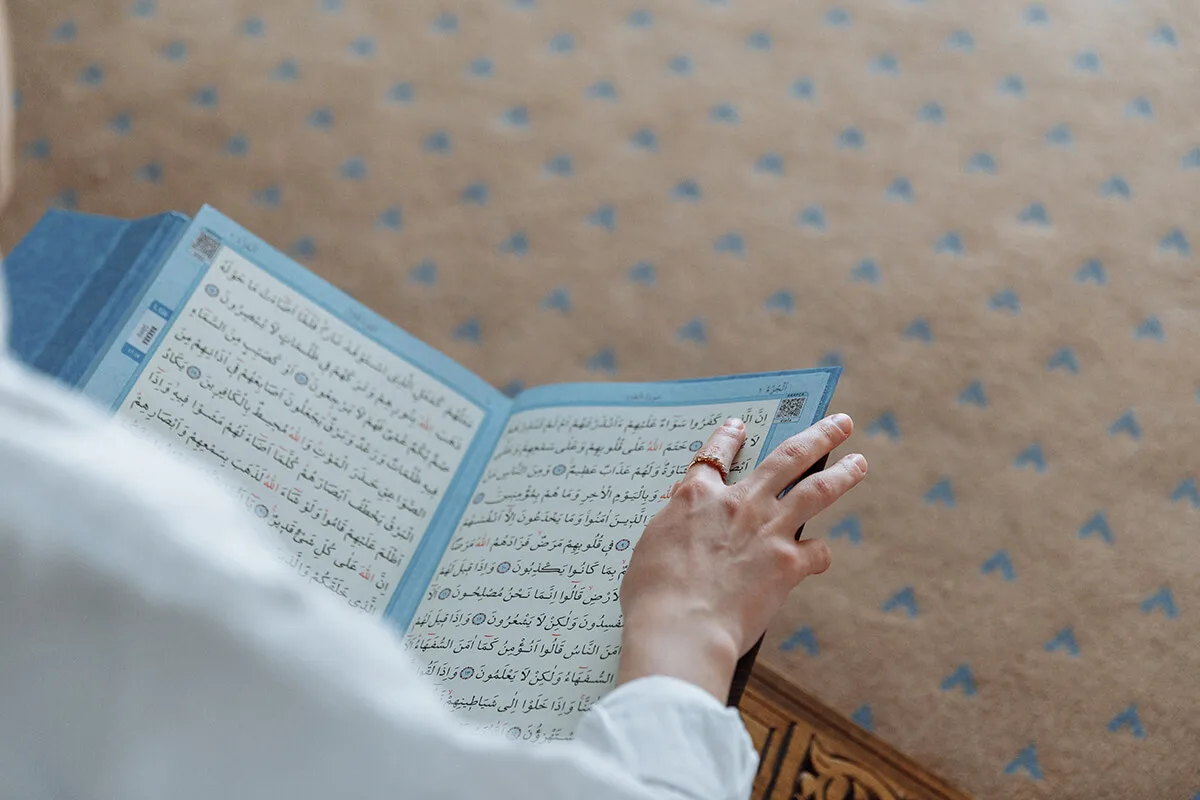
Reading the Quran is one of the best deeds and one of the best ways of drawing closer to Allah. It is recommended for every believer, man or woman, young or old, to read the Quran often, for its benefit is great. Allah says: “Indeed, this Quran guides to what is most upright” (Al-Isra, 9); He also says: “Say: for those who believe, it is a guidance and a healing” (Fussilat, 44); and: “And this is a Book We have sent down, blessed, so follow it and be mindful of Allah, that you may receive mercy” (Al-An‘am, 155); and: “This is a message for mankind, that they may be warned by it, and know that He is only One God, and that those of understanding may take heed” (Ibrahim, 52).
Among the hadiths on the merit of reading Surat Al-Kahf on Friday, the Prophet ﷺ said: “Whoever reads Surat Al-Kahf on Friday, a light will shine for him between him and the Ancient House (the Kaaba),” narrated by Al-Bayhaqi in “Shu‘ab al-Iman”.
Dar al-Ifta has affirmed that it is recommended to read the Quran every day, and especially Surat Al-Kahf on Friday. It is narrated from Abu Sa‘id al-Khudri that he said: “Whoever reads Surat Al-Kahf on the night of Friday, a light will shine for him between him and the Ancient House.” Narrated by Ad-Darimi and authenticated by Shaykh Al-Albani in “Sahih al-Jami‘” (6471).
Among the surahs recommended for reading on Friday:
Surat As-Sajdah is a Meccan surah, revealed to the Prophet ﷺ before the Hijrah. It also has other names, such as “Alif Lam Mim Tanzil” and “Tanzil as-Sajdah”. Among its merits, it is reported from Jabir (may Allah be pleased with him) that the Prophet ﷺ would not sleep until he had read “Alif Lam Mim Tanzil as-Sajdah” and “Tabarak alladhi bi-yadihi l-mulk”, because its verses contain noble meanings that combine admonitions and lessons, and bring hearts back to life.
Surat Qaf is a Meccan surah of forty-five verses, with varied themes and aims. Among its merits, Umm Hisham bint Haritha ibn an-Nu‘man (may Allah be pleased with her) said: “I only learned Qaf from the mouth of the Messenger of Allah ﷺ, who recited it in his sermon every Friday.” She added: “Our oven and the oven of the Messenger of Allah ﷺ were one and the same.”
Surat Al-Jumu‘ah is a Medinan surah, which comes after Surat As-Saff and has eleven verses. No authentic hadith reports a specific merit of reading it from the Prophet ﷺ; it therefore falls under the general merit of reading the Quran. Muslim reports in his Sahih, from ‘Abdullah ibn ‘Abbas, that the Messenger of Allah ﷺ used to recite it in the first rak‘ah of the Friday prayer.
Surat Al-Munafiqun is a Medinan surah, which comes after Surat Al-Jumu‘ah and has eleven verses. It deals with one of the most obvious traits of the hypocrites: lying and deceit. A hypocrite is one who displays Islam while hiding disbelief, or whose words and deeds differ from what he conceals. Among its merits, it is narrated: “Marwan appointed Abu Hurayra over Medina and left for Mecca. Abu Hurayra led us in the Friday prayer: he recited Surat Al-Jumu‘ah, and in the second rak‘ah ‘When the hypocrites come to you’. ‘Ubaydullah said: I met Abu Hurayra and said to him: you recite two surahs that ‘Ali used to recite in Kufa? He replied: I heard the Messenger of Allah ﷺ recite them.”
Surat Al-A‘la is a Meccan surah, which comes after Surat At-Tariq and has nineteen verses. Scholars have cited many hadiths on its merit, notably that the Prophet ﷺ recited it in specific prayers: the Friday prayer, the two Eid prayers, the Dhuhr prayer, and one rak‘ah of Witr.
Surat Al-Ghashiyah is a Meccan surah, revealed after Surat Adh-Dhariyat, with twenty-six verses. It is linked to the preceding Surat Al-A‘la, which mentions Paradise, the Fire, and in general the state of the believer and the disbeliever; Allah says there: “So remind, if the reminder should benefit,” and Surat Al-Ghashiyah then gives in detail what Al-A‘la had mentioned. Among its merits, the Prophet ﷺ regularly recited it in the second rak‘ah of the Friday prayer: “The Messenger of Allah ﷺ used to recite in the Friday prayer ‘Exalt the name of your Lord, the Most High’ and ‘Has there reached you the report of the Overwhelming?’”